
Aberdare Boys’ Grammar School
Musical and Dramatic Activities

Newspaper Report of the 1955 Annual Musical Concert
from Elfed Davies
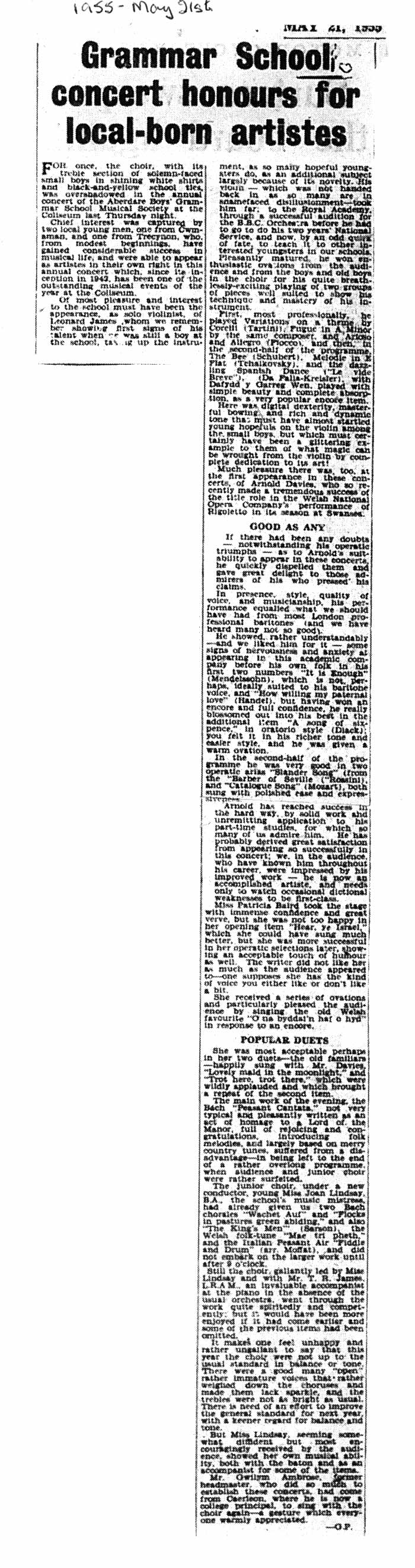
The text below is a transcript of the report from The Aberdare Leader of 21st May 1955. An image of the original article can be seen using the link at the bottom of this page.
Grammar School
concert honours for
local-born artistes
FOR once, the choir, with its treble section of solemn-faced small boys in shining white shirts and black-and-yellow school ties, was overshadowed in the annual concert of the Aberdare Boys’ Grammar School Musical Society at the Coliseum last Thursday night.
Chief interest was captured by two local young men, one from Cwmaman, and one from Trecynon, who, from modest beginnings, have gained considerable success in musical life, and were able to appear as artistes in their own right in this annual concert which since its inception in 19421, has been one of the outstanding musical events of the year at the Coliseum.
Of most pleasure and interest to the school must have been the appearance, as solo violinist, of Leonard James2 whom we remember showing first signs of his talent when he was still a boy at the school, taking up the instrument, as so many hopeful youngsters do, as an additional subject largely because of its novelty. His violin — which was not handed back in as so many are in shamefaced disillusionment — took him far; to the Royal Academy, through a successful audition for the B.B.C. Orchestra before he had to do his two years’ National Service, and now, by an odd quirk of fate, to teach it to other interested youngsters in our schools.
Pleasantly matured, he won enthusiastic ovations from the audience and from the boys and old boys in the choir for his quite breathlessly-exciting playing of two groups of pieces well suited to show his technique and mastery of his instrument.
First, most professionally, he played Variations on a theme by Corelli (Tartini), Fugue in A Minor by the same composer, and Artosio and Allegro (Fiocco), and then, in the second-half of the programme, The Bee (Schubert), Melodie in E-Flat (Tchaikovsky), and the dazzling Spanish Dance (“Le vide Breve”), (de Falla-Kreisler), with Dafydd y Garreg Wen, played with beauty and complete absorption, as a very popular encore item.
Here was digital dexterity, masterful bowing and rich and dynamic tone that must have almost startled young hopefuls on the violin among the small boys, but which must certainly have been a glittering example to them of what magic can be wrought from the violin by complete dedication to its art!
Much pleasure there was, too, at the first appearance in these concerts, of Arnold Davies, who so recently made a tremendous success of the title role in the Welsh National Opera Company’s performance of Rigoletto in its season at Swansea.
GOOD AS ANY
If there had been any doubts — notwithstanding his operatic triumphs — as to Arnold’s suitability to appear in these concerts, he quickly dispelled them and gave great delight to those admirers of his who pressed his claims. In presence, style, quality of voice, and musicianship, his performance equalled what we should have had from most London professional baritones (and we have heard many not so good). He showed, rather understandably — and we liked him for it — some signs of nervousness and anxiety at appearing in the Catalogue Song” (Mozart), both sung with polished ease and expressiveness. Arnold has reached success in the hard way, by solid work and unremitting application to his part-time studies, for which so many of us admire him. He has probably derived great satisfaction from appearing so successfully in this concert; we, in the audience, who have known him throughout his career, were impressed by his improved work — he is now an accomplished artiste, and needs only to watch occasional dictional weaknesses to be first-class. Miss Patricia Baird took the stage with immense confidence and great verve, but she was not too happy in her opening item “Hear ye, Israel,” which she could have sung much better, but she was more successful in her operatic selections later, showing an acceptable touch of humour as well. The writer did not like her as much as the audience appeared to — one supposes she has the kind of voice you either like or don’t like a bit. She received a series of ovations and particularly pleased the audience by singing the old Welsh favourite “O na byddai’n haf o hyd” in response to an encore.
POPULAR DUETS
She was most acceptable perhaps in her two duets — the old familiars — happily sung with Mr. Davies, “Lovely maid in the moonlight,” and “Trot here, trot there,” which were wildly applauded and which brought a repeat of the second item.
The main work of the evening, the Bach “Peasant Cantata,” not very typical and pleasantly written as an act of homage to a Lord of the Manor, full of rejoicing and congratulations, introducing folk melodies, and largely based on merry country tunes, suffered from a disadvantage — in being left to the end of a rather overlong programme, when the audience and junior choir were rather surfeited.
The junior choir, under a new conductor, young Miss Joan Lindsay3, B.A., the school’s music mistress, had already given us two Bach chorales “Wachet Auf” and “Flocks in pastures green ahiding,” and also “The King’s Men” (Sarson), the Welsh folk-tune “Mae tri pheth,” and the Italian Peasant Air “Fiddle and Drum” (arr. Moffat), and did not embark on the larger work until after 9 o’clock.
Still the choir, gallantly led by Miss Lindsay and with Mr. T.R. James4, L.R.A.M., an invaluable accompanist at the piano in the absence of the usual orchestra, went through the work quite spiritedly and competently; but it would have been more enjoyed if it had come earlier and some of the previous items had been omitted.
It makes one feel unhappy and rather ungallant to say that this year the choir were not up to the usual standard in balance or tone. There were a good many “open” rather immature voices that rather weighed down the choruses and made them lack sparkle, and the trebles were not as bright as usual. There is need of an effort to improve the general standards for next year, with a keener regard for balance and tone.
But Miss Lindsay, seeming somewhat diffident but most encouragingly received by the audience, showed her own musical ability, both with the baton and as an accompanist for some of the items.
Mr. Gwilym Ambrose5, former headmaster, who did so much to establish these concerts, had come from Caerleon, where he is now a college principal, to sing with the choir again — a gesture which everyone warmly appreciated.
— G.P.
Click
here for
an image of original newspaper cutting from The Aberdare Leader. .
(Use the resize button,  to
get a readable image.)
- The first concert took place in 1941, not 1942.
- Leonard William James, (Bill James), was brought up in Fforchaman Road, Cwmaman. He attended The County School in Trecynon from 1941 to 1947. Whilst at school he attended the very first residential course of the National Youth Orchestra of Wales in July 1946 at Haberdashers’ Monmouth School for Girls. In fact he was the first leader of the NYOW, at the age of 16, under its first conductor Clarence Raybould. By this time he had also won twenty-two prizes at National Eisteddfodau. Bill left school after taking his School Certificate and went to the Guildhall School of Music in London. After college, during the 1950s, he taught at various schools in Aberdare and Cardiff, as well as playing throughout south Wales both as a soloist and in various string quartets and other instrumental combinations. He was also leader of the Cardiff Concert Orchestra. The in 1962 he was appointed Executant Tutor at University College, Aberystwyth. He became a member of University String Quartet which gave around twenty concerts each year. Sometimes the quartet was augmented with pianist Charles Clements. Leonard James died in the autumn of 1994 in Cardiganshire.
- Miss Jean Lindsay taught at the school from 1953 to 1956. She graduated in Music from U.C. Cardiff in 1953.
- Thomas Richard James, (better known as T.R.), was born in 1910 and brought up in Cwmbach at Gladstone Villa. He attended the school 1922–1928, and then attended UCW Aberystwyth with a Charles Kenshole Scholarship, gaining a 1st in Pure Mathematics in 1931 and a teaching diploma the following year. He returned to teach at his old school in 1937. He left as Head of Mathematics at Christmas 1957 to take the headship at Brynmawr Grammar School. "T.R." was active outside school, and had a very successful period as conductor of Cwmbach Male Voice Choir 1950–1958 and 1959–1981. He was also choirmaster at the Mountain Ash National Eisteddfod in 1946, and chairman and choirmaster at the Aberdare National Eisteddfod in 1956. Mr James obtained his LRAM in 1952. He died in August 1986.
- Details of the career of Gwilym Ambrose can be found in the Headmaster Section of
this website.